
Emergency Roof Repair Near Me: What Tustin Homeowners Should Do First
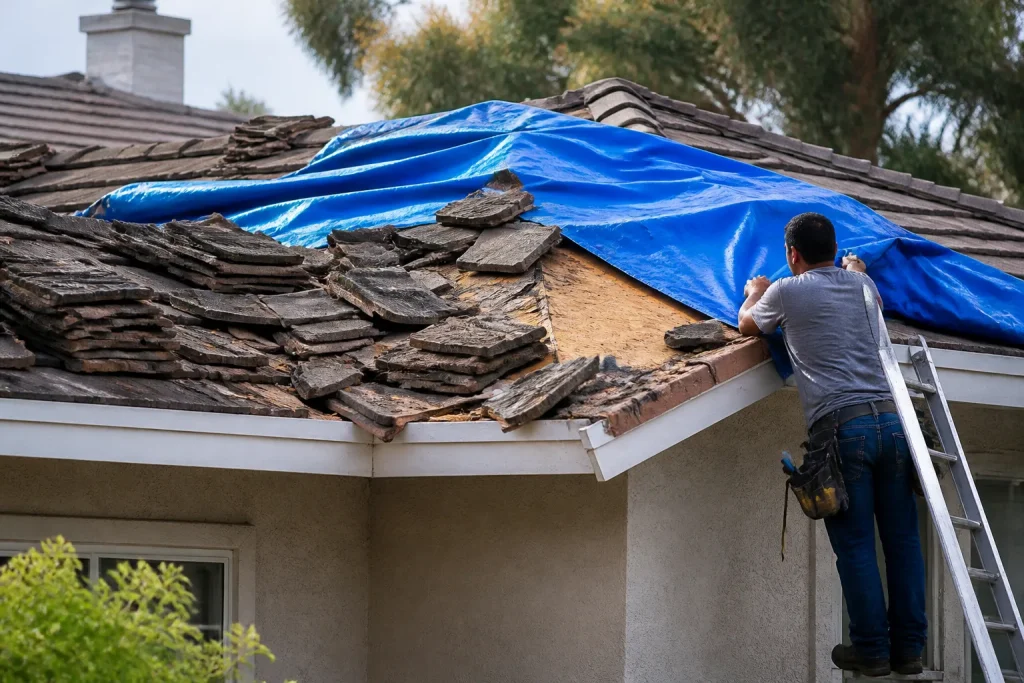
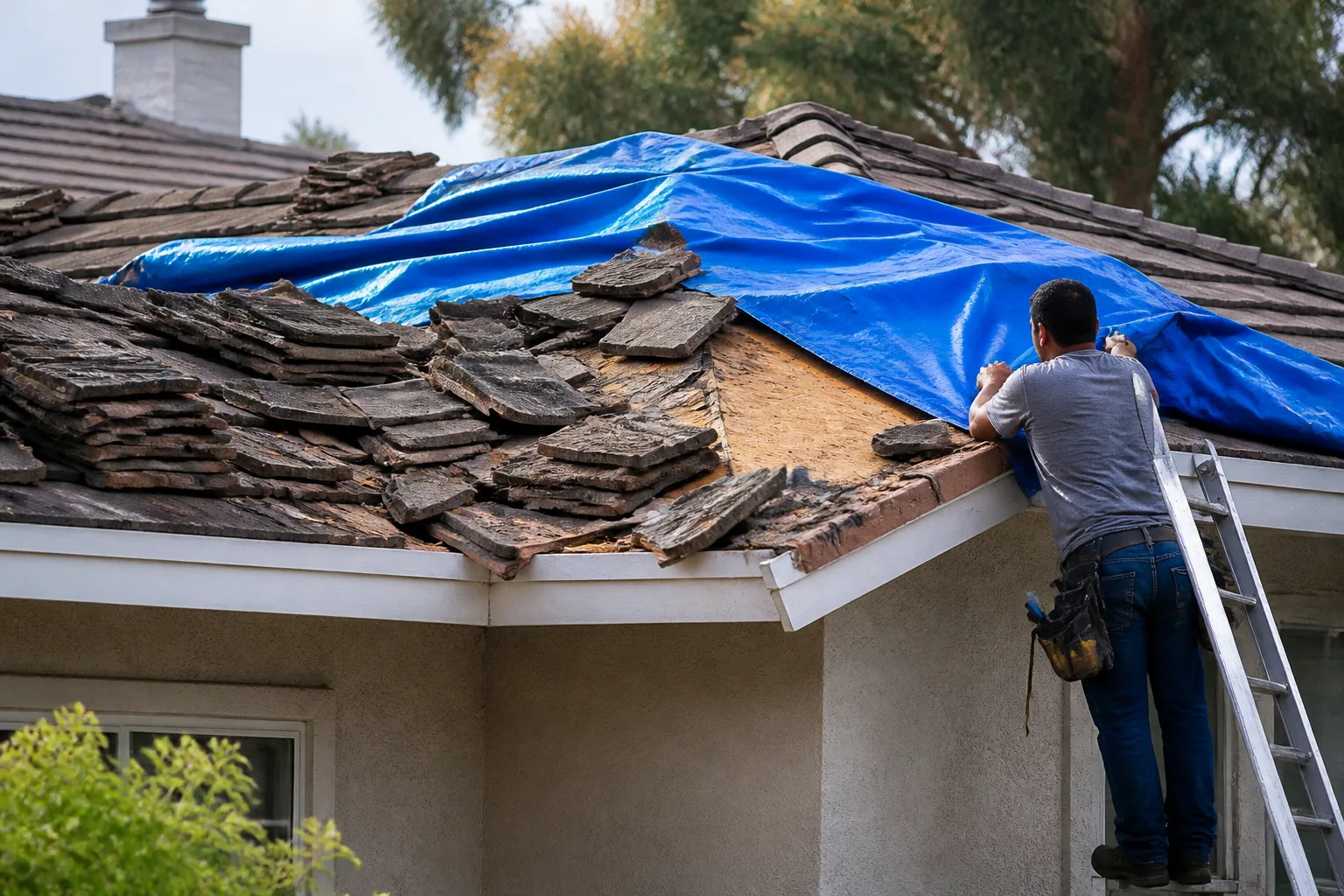
Emergency roof repair in Tustin starts with three immediate moves: contain the water inside, document the damage from the ground, and get a tarp on the breach so it sheds water without trapping moisture against the decking. The first hour determines whether you’re facing a targeted patch or a partial re-deck. If you’d rather skip the DIY containment and have someone on the roof this week, call Bellwether Roof Repair at (833) 824-0047 for a free estimate from a roofing-only crew that’s worked Tustin storm seasons for years.
The First 10 Minutes: Stop the Spread Before You Touch Anything Outside
Skip the ladder. For the first ten minutes, everything that matters is happening inside your house. The single most expensive emergency roof repair mistake we see in Tustin isn’t waiting too long to call a contractor. It’s throwing a tarp incorrectly and trapping moisture against the decking for the 72 hours until someone can get on the roof. Improper tarping causes more mold starts than the original breach ever did.
Here’s the correct interior containment sequence, in order:
- Move furniture and electronics out of the wet zone first. Water spreads faster than you think. In Tustin’s clay-tile neighborhoods like Tustin Meadows and Columbus Square, we’ve seen a ceiling leak travel fifteen feet in a half hour, ruining flooring that was never even under the visible drip.
- Place buckets under the active drips. If water is running down a wall, position a bucket at the baseboard, not at the ceiling. Water follows the stud line and will pool at the floor even when the drip appears to be six feet up.
- Relieve a bulging ceiling before it collapses. If you see paint or drywall sagging like a water balloon, place a large trash can directly beneath it. Then take a screwdriver and punch one small hole at the lowest point of the bulge. The water drains in a controlled stream instead of a hazardous sheet. Do not stand directly under it, and do not puncture until you have the can in position.
- Shut off power to that room if water is near any light fixture, fan, or outlet. A wet junction box is an electrocution hazard. When in doubt, cut the breaker. It’s a five-minute inconvenience against a real safety risk.
Most Tustin homeowners skip step three. They see the sagging ceiling, they panic, they start moving furniture, and then the drywall gives way on its own. We’ve had calls where the homeowner had a canoe-sized sog of drywall come down over a dining room table because nobody relieved the pressure sooner.
Documenting the Damage: What Insurers Actually Look For
Photographs matter, but not the ones most Tustin homeowners take. The insurance adjuster doesn’t need a close-up of a wet patch. They need context. Before any contractor arrives, take these shots in this order:
- Wide exterior shots from the front and back of the house showing the full roof surface and the storm date context. These establish that the structure was intact before the event.
- Ground-level photos of the damaged slope, zoomed in as far as your phone allows. Missing shingles, lifted flashing, cracked tiles. You should be able to point to the breach in the photo.
- Interior damage photos with a ruler or tape measure in frame. Insurers want scale. A wet spot without scale might be dismissed as pre-existing cosmetic staining.
- The first tarp job, after it’s done. This proves you took reasonable steps to mitigate further damage, which is a standard policy requirement.
- Receipts for any bucket, tarp, or plywood purchases. In Tustin, mitigation costs are generally reimbursable up to the policy’s limit. Keep the line item.
The documentation insurers most commonly cite as missing when denying a claim? The “before” shot. Without a pre-storm baseline photo of the roof in sound condition, the insurer can claim that the damage predates the storm event. We tell Tustin homeowners: take a roof photo every spring and save it. That single habit has saved tens of thousands of dollars in otherwise-contested claims.
The Tarp Protocol: Keeping Water Out Without Trapping It In
A tarp applied wrong is worse than no tarp. We’re not exaggerating. Water that gets under a poorly-anchored tarp and then has that tarp sealed over it will condense and sweat against the decking for days. In Tustin’s marine-layer humidity, especially in the canyons near Peters Canyon and the foothill streets around Lemon Heights, this creates the exact warm-damp environment where mold takes hold in 48 to 72 hours.
The goal is not to make it waterproof. The goal is to make it shed. Here’s how we approach an emergency tarp on a Tustin roof:
- Extend the tarp past the ridge by at least two feet. The ridge, not the face of the tarp, is where water enters if the tarp is too short. Water running down the roof will travel under any tarp that stops short of the peak.
- Anchor at the eave, not the field of the shingles. Sandbags or 2x4s placed along the bottom edge direct water away and keep the tarp from ballooning. Anchors placed mid-roof, like nails driven through the tarp, create fresh punctures. Anchor points should land in the underlying, still-sound shingle or on the fascia board where possible.
- Leave the ridge side open by an inch or two. This is the counterintuitive step. You want the tarp to let air move under it. A fully-sealed tarp, with anchors at both ridge and eave, traps humidity and encourages condensation. The tarp sheds water down and off, while the open ridge side allows any ambient moisture to vent.
- Cut the tarp back from any roofline penetrations like plumbing boots, attic vents, and chimney bases. Wrapping a tarp tightly around a plumbing boot creates a ponding point. Water collects, sits, and seeps through the very point you’re trying to protect.
If you can’t safely get on the roof, don’t. Call a contractor who does emergency tarping. The Tustin fire department and city code enforcement don’t issue permits for temporary tarping, but homeowners should still document the tarp with a photo and call their insurance adjuster the same day. Adjusters respond faster when they see the homeowner has already acted.
How to Spot a Storm Chaser Before You Hand Over a Deposit
Every serious storm in Orange County sends a fresh crop of unsolicited “emergency roofing” contractors through Tustin’s neighborhoods. Some are legitimate. Many are not. They knock on doors the morning after a storm, say they noticed damage, and offer to start work that afternoon. The pressure to sign is the tell.
Before you let anyone on your roof, ask these three questions. A legitimate contractor will answer all three without blinking:
- “What’s your physical business address in Orange County?” A storm chaser will give a PO box or a city name with no street. A local contractor will hand you an address and offer to meet you at the yard.
- “Which manufacturers are you authorized to install?” A roofing-only contractor with real product access can name their manufacturer lineup without pausing. If they say “all of them” or mumble something about “whatever you want,” they’re a broker with no direct manufacturer authorization. We hold authorizations with seven manufacturer lines including GAF, CertainTeed, Owens Corning, IKO, Atlas, Tamko, and Boral, so we can match the repair product to the existing roof rather than pushing whatever single brand pays the highest dealer margin.
- “Will you provide a written scope before any deposit?” The answer should be an immediate yes. A written, line-item scope of work protects you, and honestly, it protects the contractor too. If they want a deposit before they’ll write anything down, walk away.
We pulled one out of a garage over in Tustin’s Westgate neighborhood last fall. The homeowner had already signed with a door-knocker who took a $2,400 deposit for “emergency tarping and repairs” and was never seen again. The Tustin Police Department took the report, but the money was gone. This happens every storm season, without fail.
What the 48 to 96 Hour Window Really Looks Like in Tustin
Here’s what to expect after a major storm passes over Tustin. Contractor availability tightens fast. By 24 hours after a heavy rain event, most reputable Tustin roofing crews are booked for the next several days. By 48 hours, you’re scheduling for the following week at best. Plan realistically.
The sequence that works, based on what we’ve seen across Tustin’s storm seasons:
- Hour 0 – 2: Interior containment, documentation photos, initial call to your insurance carrier.
- Hour 2 – 24: Emergency tarping (DIY or contractor), second call to insurers if you haven’t heard back, start contacting roofers for a repair estimate.
- Day 2 – 3: Contractor assessment and written scope. If you’re in a Tustin HOA, especially in the planned communities around Tustin Ranch, check your CC&Rs. Some HOAs require that exterior roof work be submitted for architectural review even in emergency scenarios.
- Day 3 – 7: Repairs begin, weather permitting. Most single-breach repairs on Tustin asphalt shingle roofs take a full day including tear-out, deck inspection, underlayment, and shingle replacement. Tile roofs run longer because of tile sourcing lead times.
On permit timelines: emergency roof repair, defined as work necessary to stop active water intrusion, generally doesn’t require a building permit in Tustin. But if the decking is compromised and the repair expands into structural replacement, a permit kicks in. The City of Tustin’s building division typically turns residential repair permits around in a few business days when the work is storm-related. It’s not a bottleneck, but it is a reality. A contractor who’s worked Tustin’s permit process keeps the schedule honest. A contractor who brushes off the permit question entirely is one you should question.
If the breach is over a finished living space, that’s the moment to call a pro. Climbing a wet ladder in Tustin’s post-storm mud is genuinely dangerous. We inspect before we recommend, and the inspection establishes an objective baseline before any financial commitment gets made. That goes for repair or replacement. If you’ve got a roof over your head that’s failing in a storm, you don’t need a sales pitch. You need an accurate answer about whether this is a roof repair in Yorba Linda-style quick patch or something closer to a roof replacement in Yorba Linda decision. The roof inspection in Yorba Linda model is the same in Tustin: look, measure, assess, and recommend honestly.
Related Services in Tustin
When the storm damage is done and the question shifts from “contain this” to “solve this for good,” we handle three things under one roof: emergency roof repair, full roof replacement, and storm-damage roof inspections. Repair when repair is right, replace when replace is right. If you want a second opinion on what a door-knocker told you, we’ll give it to you straight. The Bellwether Roof Repair home page has our full service breakdown.
What happens when you call
- 1
A real person answersNo phone trees — you reach a local pro.
- 2
You get an upfront price rangeHonest numbers before anyone is dispatched.
- 3
A background-checked tech heads outLicensed & insured, dispatched right away.
- 4
You approve before work beginsNothing starts until you say go.
The Bottom Line
The first hour after discovering a roof leak in Tustin is about control. Control the water inside. Control the airflow under the tarp. Control the documentation. Control who gets on your roof. Get those four right and you’ve turned an emergency into a scheduled repair. Get the tarp wrong and you’ve added mold remediation to the bill.
If you’re in Tustin and need help, Bellwether Roof Repair offers free estimates. Roofing is all we do. Call (833) 824-0047 and we’ll walk you through the first hour, the first day, and the full repair scope.
Frequently Asked Questions
No. Emergency repairs to stop active water intrusion are treated as exempt from permitting under Tustin’s building code. However, if the repair expands to structural decking replacement or extends beyond the original damage area, a permit becomes required. The Tustin Community Development Department processes storm-related repair permits on an accelerated timeline, usually a few business days.
For a standard shingle breach on a Tustin home, count on a full day for the repair proper. That includes removing damaged shingles, inspecting the underlayment and decking for moisture, replacing any compromised decking, installing fresh underlayment, and re-shingling with matched product. If the home has clay or concrete tile, expect 2 to 3 days once the matching tile is sourced.
Yes, with one hard rule: use a ladder only if you’re comfortable on one and the ground is dry. A wet Tustin clay soil is slick and a ladder set on mud can slide. The tarp itself should extend past the ridge by at least two feet, be anchored at the eave rather than mid-roof, and leave the ridge side slightly open so air circulates under the tarp. A sealed tarp traps humidity against the decking.
In most cases, yes, provided the damage was caused by a covered peril like wind or hail and you took reasonable steps to prevent secondary damage. Document everything: wide exterior shots, close ground shots of the damage, interior photos with scale, and receipts for tarps or buckets. Call (833) 824-0047 if you want a free estimate and a written scope to take to your adjuster.
Written by the team at Bellwether Roof Repair, serving Tustin since 2018.
Need Roofing Help?
Call Bellwether Roof Repair — licensed & insured, here with fast after-hours help in Yorba Linda.
(833) 824-0047