

Last updated October 31, 2026
 Architectural shingles
 Metal roofing
 Tile roofing
 GAF
 Owens Corning
 Flat & low-slope
Free roof inspection with deck photos before we talk money - GAF and Owens Corning certified installation
Roof Repair Troubleshooting: Common Problems and How to Fix Them
A ceiling stain directly below a skylight is rarely caused by the skylight. Water travels along rafters and decking and stops where it finds an exit, which means the actual breach can be 6 to 12 feet upslope from where the stain appears. This guide is built around that single, counterintuitive truth. We’re going to teach you how to trace from effect back to source, the same way a roofing contractor in Tustin does when they climb into an attic with a flashlight and a moisture meter. By the time you finish reading, you’ll know how to read the signs your roof is giving you, which problems you can document yourself, and which ones need professional attention this week, not next month.
Styles & brands we work with
Quick Answer
Roof repair troubleshooting starts with locating the actual source of water intrusion, not the visible symptom. This means reading water stains in the attic, understanding how different roofing materials fail, and acting within the 90-day window before small problems like nail pops become re-flashing jobs. The most common issues homeowners face are flashing failures, shingle granule loss, membrane breaches, and ventilation problems, and each one leaves a distinct diagnostic signature.
Table of Contents
- The First Principle: Water Travels, So Should You
- Reading the Attic: The Diagnostic Method No One Teaches
- Three Failure Signatures: Flashing, Membrane, and Shingle
- Granule Loss: Two Different Problems, Two Different Predictions
- Nail Pops and the 90-Day Clock
- Why South-Facing Slopes Fail Differently in Tustin
- Document or Report: Your Decision Matrix
- Common Mistakes to Avoid
- When to Call a Professional
- Frequently Asked Questions
- The Bottom Line
The First Principle: Water Travels, So Should You
Here’s the thing most DIY guides never mention: your roof is a system of slopes, seams, and penetrations, and water will exploit every one of them before it shows up on your ceiling. When we inspect roofs in Tustin, we rarely find the leak directly above the stain. We find it upslope, sometimes at a vent pipe, sometimes at a valley, sometimes at a flashing joint that looks perfectly fine from the ground. The stain on your ceiling is the exit point, not the entry point. Water enters, runs along the decking, follows the grain of the plywood, hits a rafter, runs along that, and finally drops where the path ends. That’s why a stain below a skylight is usually a flashing failure at the skylight’s uphill edge, not the skylight itself. And it’s why a stain in a corner bedroom might actually be coming from a vent pipe on the opposite side of the attic. Before you grab a ladder, understand this: the leak is almost never where you think it is.
Reading the Attic: The Diagnostic Method No One Teaches
Contractors don’t guess, and neither should you. The single most reliable diagnostic tool you have is already in your house: your attic. Here’s the method we use on every roof inspection, adapted for a homeowner who wants to know what they’re looking at.
- Go up on a dry day, mid-morning. You want daylight, and you want the wood dry enough that old stains are visible but new moisture is gone. Bring a flashlight and a phone camera.
- Locate the stain on your ceiling from below. Measure its position from two walls. Transfer those measurements to the attic floor above.
- Look up at the decking directly above that point. If the decking there is dry, the water is coming from upslope. If it’s damp or stained, you’re closer to the source.
- Trace the rafters upward. Follow the rafter line that runs through or nearest the stain. Look for water marks on the side of the rafter, not just on the decking. Water runs along the rafter’s edge before it drips.
- Look for daylight. Any pinhole of light through the decking is a penetration point. Mark it. Take a photo. That’s your leak, even if it’s 10 feet from the stain.
This is the method we use when we get called out to a home in Tustin for Roof Repair services where the homeowner has already tried to patch the wrong spot. It takes 20 minutes and it changes everything.
Three Failure Signatures: Flashing, Membrane, and Shingle
Every roofing failure leaves a signature on the inside of your attic. Once you know what to look for, you can identify the failure type without ever climbing onto the roof deck. Here are the three most common ones and what they look like from inside.
Flashing Failure
Flashing is the metal or membrane material that seals the joints where the roof meets a vertical surface: chimneys, skylights, vent pipes, walls. When flashing fails, water enters in a narrow, concentrated stream. Inside the attic, you’ll see a distinct, thin water line running down a rafter or a dark, narrow stain on the decking. It will be localized. If the leak is active, you can sometimes trace it to a single drip point. In our experience, flashing failures account for more calls in Tustin than shingle failures, especially on older homes where the original flashing was never maintained. The fix is usually targeted, but it’s also the one place where a cheap patch disguised as a repair will fail again within a season. Roof repair on flashing is precision work, not caulk work.
Membrane Failure
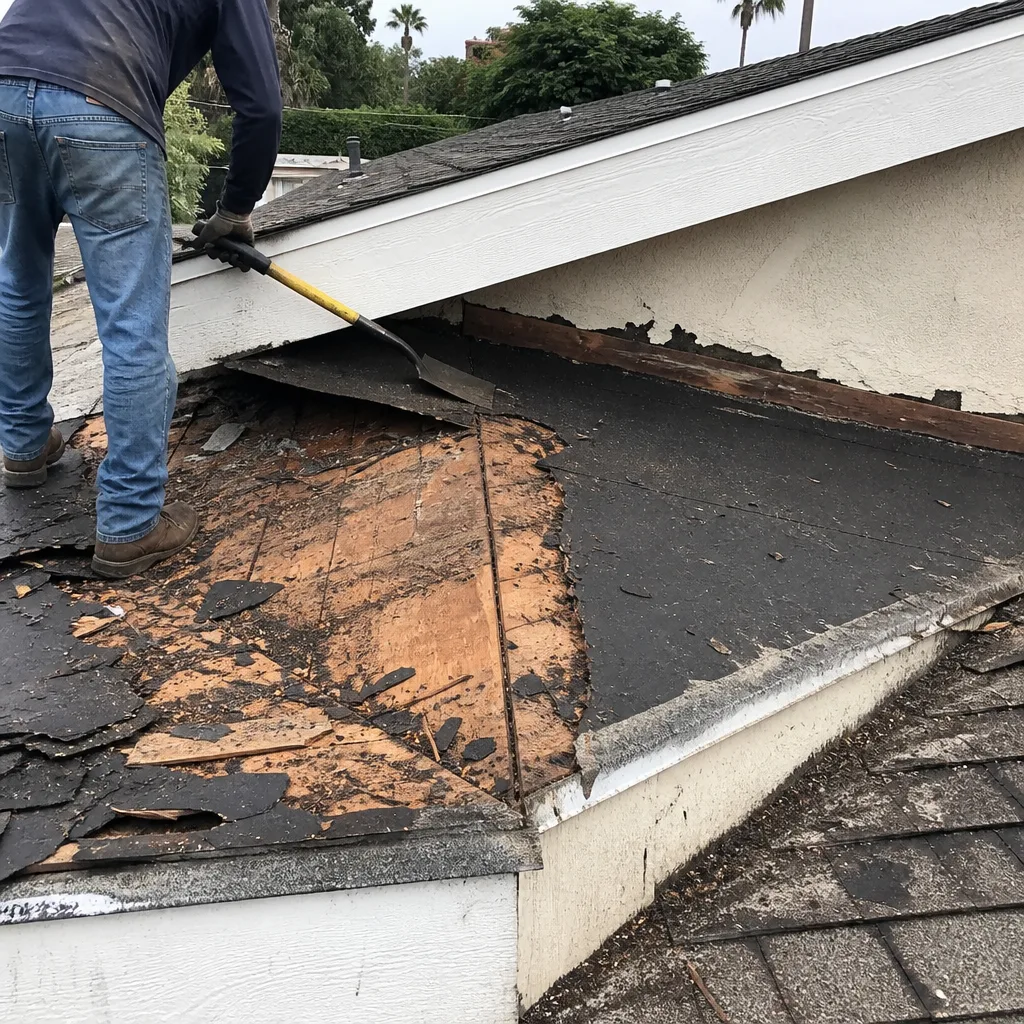
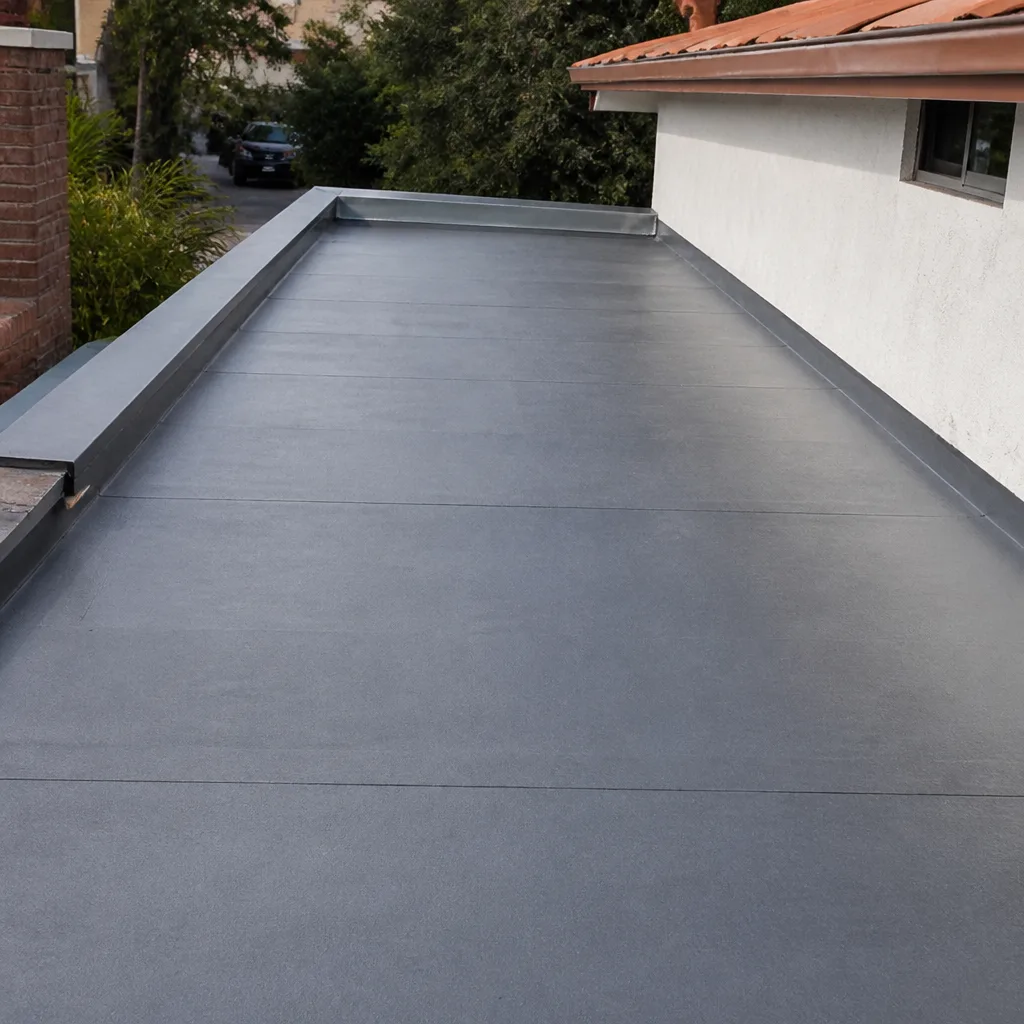
Membrane failures happen on flat or low-slope sections, or under tile and shingle at valleys and eaves. The signature is different: broad, diffuse staining across a wide area of decking, not a thin line. Water spreads under the membrane and travels in a sheet. If you see a large, irregular dark patch on the underside of your roof deck, and the staining has no clear channel or stream, you’re looking at membrane failure. This is more common in Tustin on additions with low-pitch roofs, patio covers, and on tile roofs where the underlayment has aged past its functional life. The repair is not a patch. The section of membrane needs to be replaced, and the covering material removed and reinstalled. It’s a bigger job than it looks from the inside, which is why it’s worth getting an accurate assessment before you commit.
Shingle Failure
Shingle failure shows up as isolated, repeating stains. If you see a cluster of small, separate water marks on the decking, each one roughly the size of a fist, you’re likely seeing water that got under individual damaged shingles. Broken shingles, blown-off tabs, and severe granule loss expose the asphalt layer, and water seeps through the nail holes or cracks. The inside signature is scattered drops, not connected streams. This often happens on the windward side of the roof or on slopes that take direct sun. The fix is typically several shingle replacements, but only if the decking underneath is sound. If the decking is soft, the repair expands to include sheathing replacement.
Granule Loss: Two Different Problems, Two Different Predictions
Granules are the mineral particles embedded in asphalt shingles. They protect the asphalt from UV light. When they come off, shingles age faster. But where the granules come off matters more than most homeowners realize. Here’s how to read it.
Granule loss in gutters, especially after the first rain of fall, is mostly normal for shingles in their first few years. Manufacturing leaves loose granules on the surface, and they wash off. But if you’re seeing heavy granule accumulation in gutters every season, year after year, your shingles are deteriorating. This is wear, and it’s a signal that your roof is approaching the back half of its service life. It doesn’t mean replacement tomorrow. It means you should start planning, and it means you should have the roof inspected to find out how much life is actually left.
Granule loss on south-facing slopes is a different problem with a different prediction. In Tustin, south-facing slopes take the full blast of afternoon sun. The asphalt under the granules heats and softens. When granules are gone, the asphalt oxidizes, becomes brittle, and cracks. If you see bare patches with exposed asphalt on south-facing sections while north-facing sections still have full granule coverage, you’re seeing accelerated UV degradation. That slope is aging faster than the rest of the roof. The prediction: that section will fail first. The fix is sometimes a partial re-roof of the affected slope, done in a color and product that matches the rest of the roof. We’ve done many of these in Tustin hillside neighborhoods where the south slope bakes all summer.
Nail Pops and the 90-Day Clock
A nail pop is exactly what it sounds like: a nail that has worked its way up through the shingle, pushing a small bump through the surface. It usually happens because the original nail wasn’t driven flush or because the decking moves with temperature and humidity swings. In Tustin’s dry-wet cycles through winter and spring, nail pops are common. The temptation is to hammer it back down and move on. We’ve seen that go wrong too many times to recommend it.
Here’s the 90-day risk. A nail pop creates a small hole in the shingle’s surface. Water enters that hole, runs down the nail shaft, and soaks into the decking below. Within the first 30 days, the shingle is still largely intact, and a proper fix is replacing the nail and sealing the hole. Within 90 days, the water has spread into the surrounding wood, and the shingle around the nail has loosened. The area around the puncture has become a leak path. At that point, the repair requires removing shingles in the surrounding area, checking the decking, repairing or replacing damaged wood, and re-flashing the section with new underlayment. What was a $300 repair becomes a $1,200 re-flashing job. The lesson is not to hammer it yourself. The lesson is to get it fixed before the 90-day clock runs out.
Why South-Facing Slopes Fail Differently in Tustin
Tustin has a Mediterranean climate: hot, dry summers, mild winters, and just enough rain to find every weakness in a roof. The pattern matters because roofs here don’t fail from rain alone. They fail from sun, then rain finishes the job. South-facing slopes in Tustin can reach 150 degrees on the surface in August. That heat bakes the asphalt in shingles, dries out sealants at flashing joints, and causes thermal expansion and contraction at every metal-to-shingle transition. The result is that most Tustin roofs show their first signs of failure on the south and west exposures. If you’re troubleshooting and you see granule loss, cracked caulk at flashings, or curling shingle edges on the south slope but not the north, you’re looking at heat-driven failure, not storm damage. That changes the repair approach. The fix is typically a heat-resistant shingle from manufacturers like CertainTeed or GAF on the affected slope, and a targeted rebuild of the flashing points that have been baked open.
Document or Report: Your Decision Matrix
Not every roof issue needs a contractor this week. Some need documentation and monitoring. Some need a professional assessment the same week. For Roofing Emergency Preparedness Guide for Tustin Homes, see our dedicated resource. Here’s a simple decision matrix that will save you from both panic and neglect.
Document and monitor if:
- The attic stain is dry, small, and hasn’t changed in size across two rainy seasons.
- Granule loss is light and seasonal, with no bare asphalt showing.
- You see a single nail pop with no water staining around it in the attic.
- Flashing caulk is starting to crack but hasn’t separated from the metal.
Call a professional this week if:
- The attic stain is damp or growing, or you see active water during rain.
- You see daylight through the decking anywhere in the attic.
- Bare asphalt is visible on any slope, especially south-facing.
- Flashing has lifted or separated, and you can see a gap between metal and shingle.
- You find multiple nail pops, or one nail pop with dark staining around it.
When in doubt, the line between “monitor” and “call” is daylight in the attic. If you can see light, water can get in. That’s a call, not a calendar note.
Common Mistakes to Avoid
- Sealing the first stain you see. Caulking the ceiling below the stain does nothing to stop water entering 8 feet upslope. You’ll just redirect it to a new exit point, usually a light fixture.
- Ignoring south-slope granule loss because the roof looks fine from the street. In Tustin, the side of your roof that faces the sun is often the first to fail while the front slope still looks new. Walk the back of the house.
- Hammering down a nail pop without checking the decking. The nail is a symptom, not the cause. The hole underneath is the problem, and hammering it flat does nothing to seal it.
- Replacing one shingle on a slope that has multiple popped nails. If you have one nail pop, you usually have three more about to surface. Replacing shingles one at a time on a failing slope is a band-aid on a limb.
- Using roof sealant on flashing that has separated. Sealant is not a structural fix. If flashing has lifted from the roof plane, it needs to be mechanically refastened and re-covered under the shingle course, not glued down.
- Painting over a ceiling stain before finding the source. This is the most common mistake in Tustin rental properties we’re called to after the fact. The stain comes back, the paint bubbles, and the real repair is now more expensive because the leak had more time to spread.
When to Call a Professional
You should call a professional when the problem involves structural decking, active water entry, or damage you can’t see from inside the attic. That means daylight through the decking, a damp or growing stain, flashing that has separated, or granule loss that has exposed bare asphalt. These are not conditions a sealant tube can fix, and waiting pushes the repair cost up while the roof continues to age. At Bellwether Roof Repair home, we’re a roofing-only contractor, and our technicians diagnose from the attic first, then the roof surface. We don’t sell replacement unless the evidence supports it. Repair when repair is right, replace when replace is right. If you’re in Tustin and you’ve found something you can’t identify, Bellwether Roof Repair offers free estimates. Call (833) 824-0047 and we’ll come look before you spend anything.
Frequently Asked Questions
Start in the attic, not on the roof. Locate the ceiling stain from below, transfer the position to the attic floor, then trace the rafters upslope until you find water marks, daylight, or a damp patch on the decking. The actual breach is usually 6 to 12 feet above where the stain appears. In Tustin, where most roof slopes are moderate, this upslope distance is consistent enough that we check the entire rafter run above any stain before we ever step onto the roof deck.
Most roof leaks appear as a brown or yellow ceiling stain, often in a ring shape, that grows or darkens after rain. In the attic, the leak shows as a dark water line along a rafter, a damp spot on the underside of the decking, or a small point of daylight. If the stain is dry and unchanged, it’s an old leak. If it’s damp, it’s active. “Water travels” is the point to remember: the visible stain is rarely directly below the entry point. Call (833) 824-0047 if you’re unsure whether what you’re seeing is active water or old history.
Roof repair in Tustin ranges from $300 to $450 for a single nail pop fix or shingle replacement, $500 to $1,200 for a flashing repair at a chimney or vent, and $1,000 to $2,500 for a membrane section replacement on a low-slope area. For a deeper dive, see our Roofing Cost Breakdown: The Tustin Homeowner’s Reference for 2026. The final number depends on the breach type, the decking condition, and whether the affected area requires matching products from our manufacturer lineup, which includes GAF, CertainTeed, Owens Corning, IKO, Atlas, Tamko, and Boral. Call (833) 824-0047 for an exact quote. Estimates are free.
You can replace a single shingle yourself if the decking underneath is sound and you can safely work from the ground or a properly secured ladder. But if that shingle failed due to nail pops, granule loss, or flashing separation, replacing it without addressing the cause means you’ll be back out there after the next rain. Most homeowners in Tustin are better served by having a roofing-only contractor look at the slope as a whole before patching one visible shingle.
First, identify where the granule loss is. Light, seasonal granule buildup in gutters is normal. Bare asphalt or heavy, year-after-year accumulation is not. Check the south-facing slope specifically. In Tustin, south slopes oxidize faster than north slopes. If the north slope still has full granule coverage and the south slope is bare, you’re seeing UV-driven aging on one section, and that section will fail first. The fix is a targeted repair or partial re-roof with UV-resistant products. Brands like Tamko and Boral both have lines we’ve used for exactly this application.
Most roof repairs take 2 to 4 hours on site. That includes attic inspection, decking assessment, material match, and the repair itself. Larger repairs, like membrane section replacement or flashing rebuilds around multiple penetrations, can run 6 to 8 hours. The attic inspection is the part that separates a real diagnosis from a guess, and it’s the first thing we do on every service call. Roofing is all we do, which means our crews are sized for repair, replacement, and inspection without the scheduling conflicts a general contractor brings. All roofing estimate calls are free at (833) 824-0047.
The Bottom Line
The core lesson of roof repair troubleshooting is that the visible symptom is not the repair location. A ceiling stain is an exit point. A curling shingle is a surface signal. Granule loss is a predictor. Each one points upslope, through the attic, toward the actual breach, and the fastest way to find it is to read the failure signature from the inside first. In Tustin, where heat-driven south-slope failures outnumber storm damage most years, understanding this process saves you from paying for the wrong repair twice. Document what you can, call early for what you can’t, and for more guides & resources, explore our blog. Remember: seven manufacturers, one standard. The right material for your roof is the one that matches the actual failure, not the one that’s easiest to sell. If you’re in Tustin and you’ve found something that concerns you, Bellwether Roof Repair offers free estimates. Call (833) 824-0047.
Written by the team at Bellwether Roof Repair, serving Tustin since 2018.
See the difference
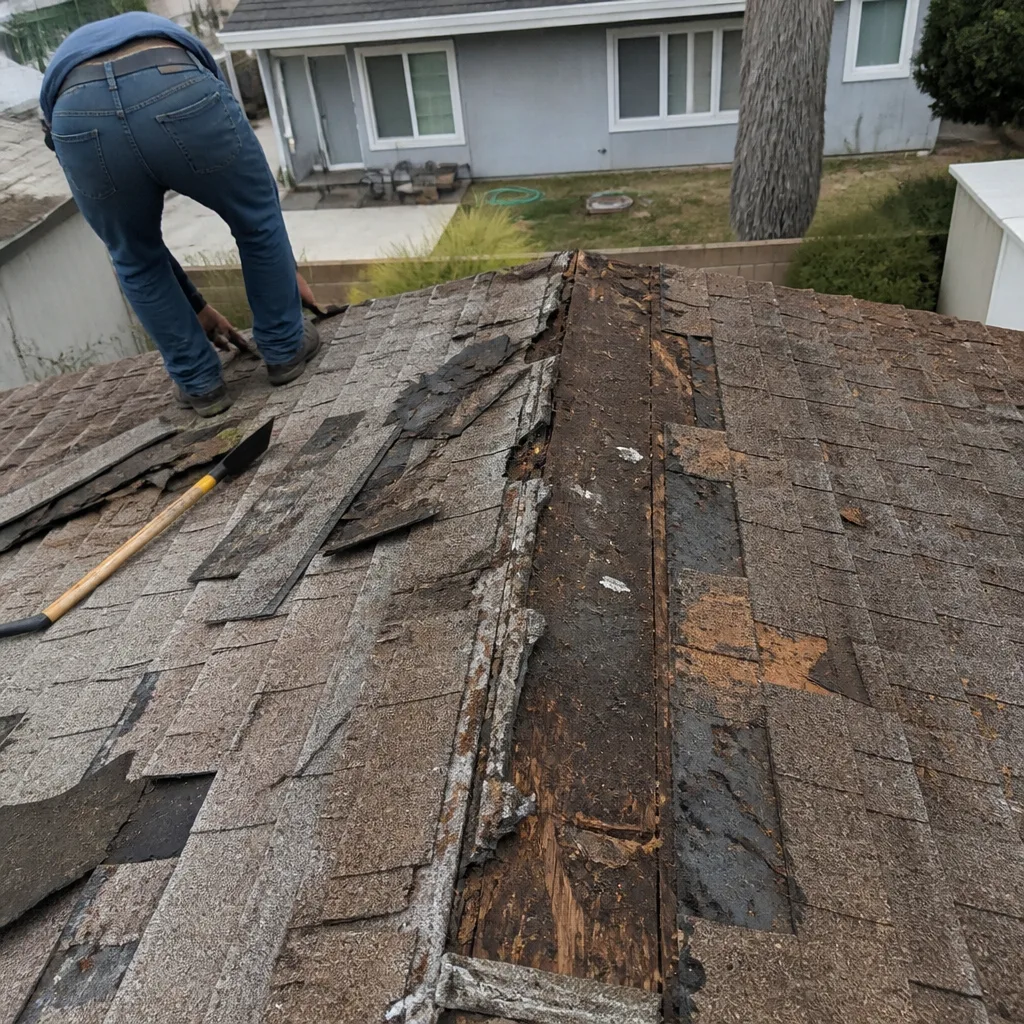 Before
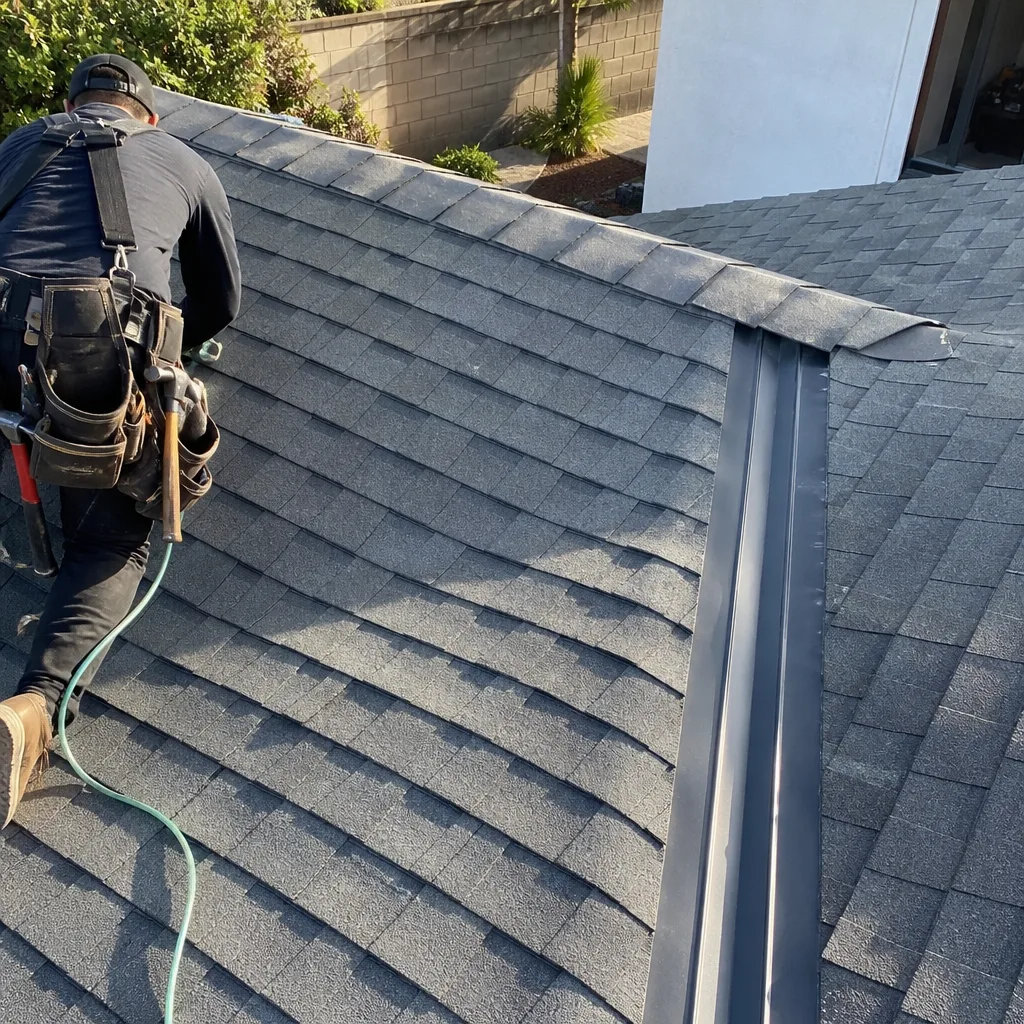 After
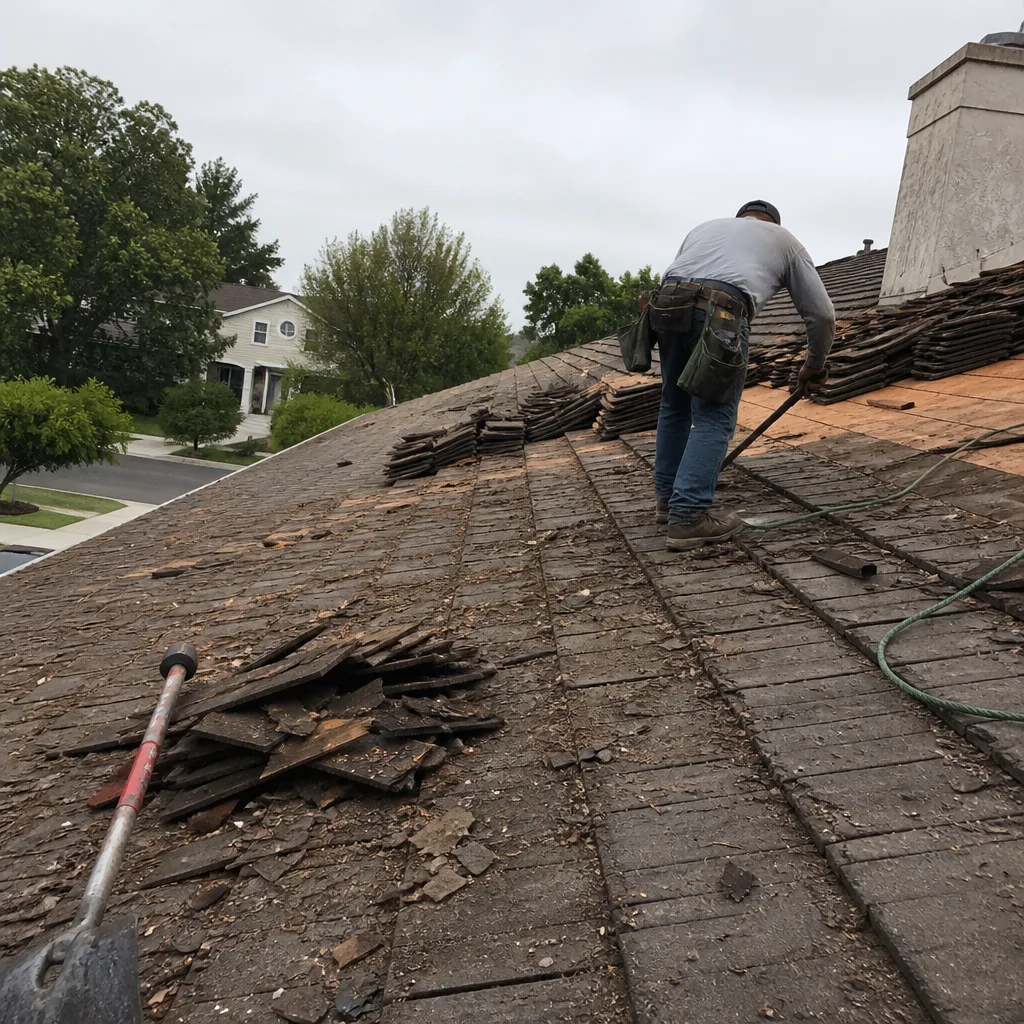 Before
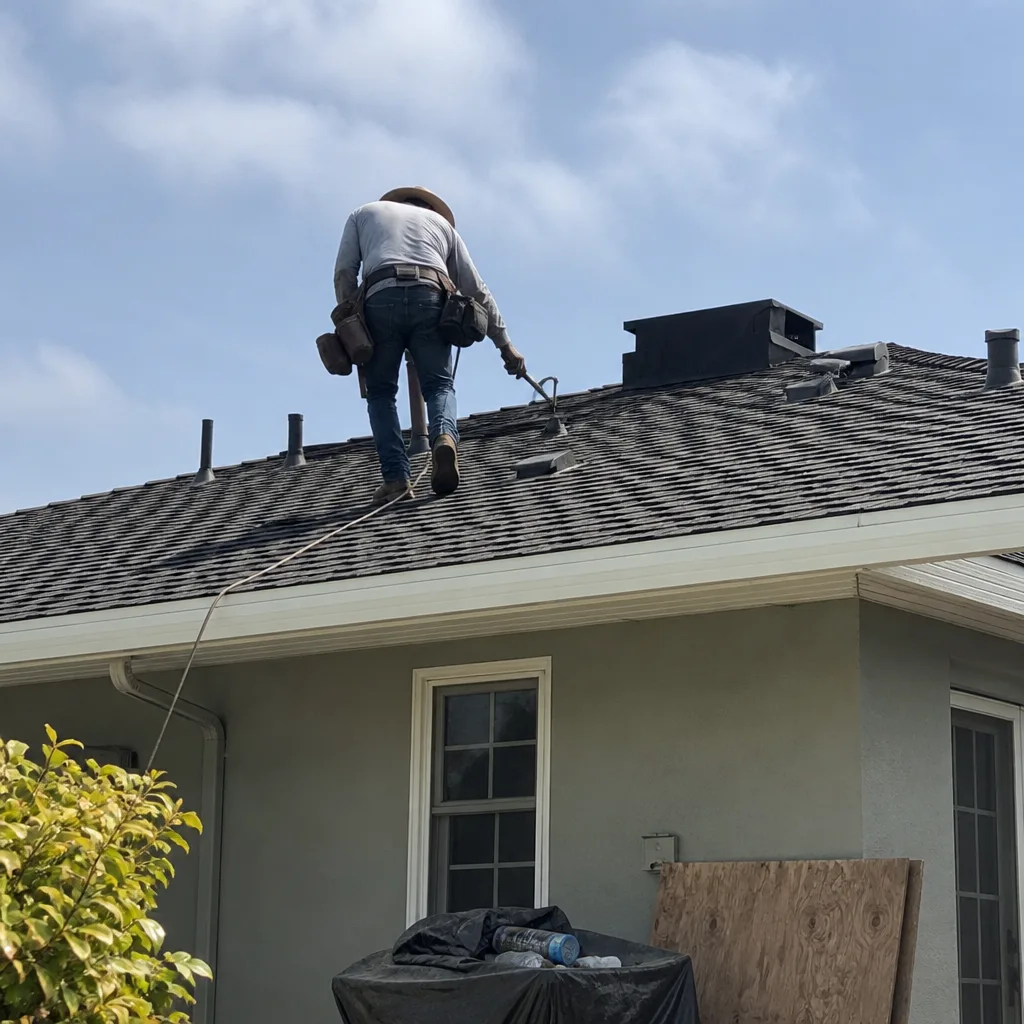 After
 Before
 After